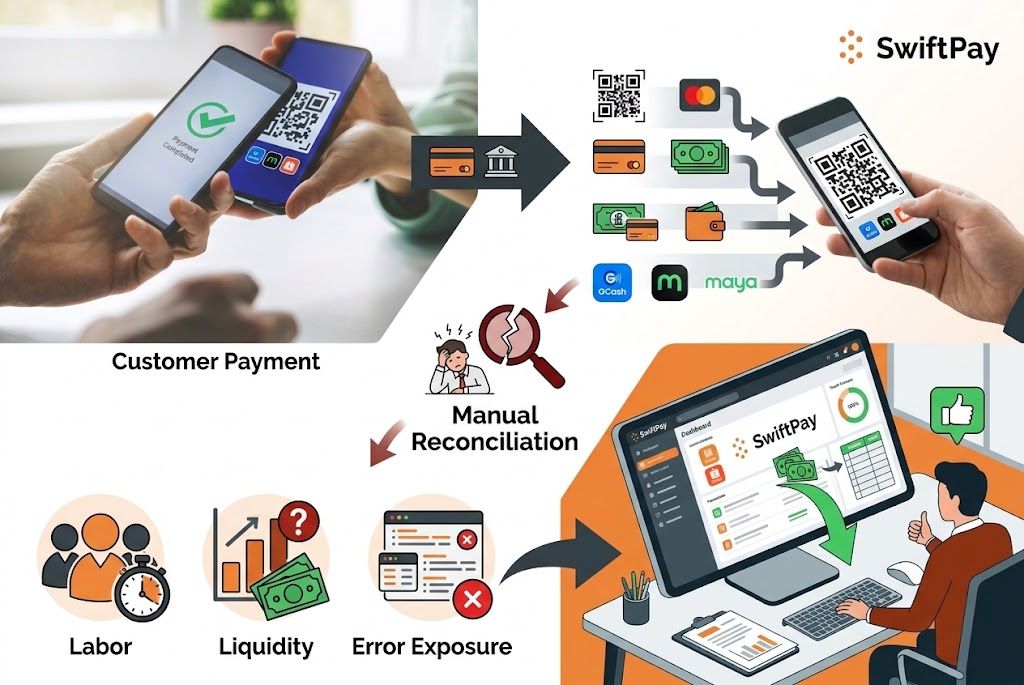
The consumer-facing digital payment revolution in the Philippines is largely a finished chapter. According to the Bangko Sentral ng Pilipinas (BSP) 2024 Report on the Status of Digital Payments in the Philippines, digital payments now account for 57.4% of monthly retail transaction volume and 59% of value. Driven by widespread QR Ph adoption and fully realized e-wallet networks, the front-end machinery required to accept a payment is now largely a solved problem.
However, beneath this massive growth lies a sharp operational friction point that high-volume enterprises are only now beginning to reckon with: the back office. While money moves instantly on the front end, the internal infrastructure required to clear, settle, and manually reconcile those transactions into enterprise resource planning (ERP) and accounting software has not kept pace.
The Invisible Operational Tax
For Chief Financial Officers (CFOs), heads of finance, and treasury leaders in high-volume sectors — such as insurance, manufacturing, large-scale lending, and real estate — the surge in digital transactions has inadvertently created an administrative crisis. To meet customer preferences, large enterprises intentionally run multiple payment providers. Because these systems are rarely unified, finance teams are left to manually match transaction records across multiple disparate bank portals and dashboards.
This decentralized system imposes a severe back-office tax. Drowning in disconnected spreadsheets, operations teams face invisible labor costs and heightened exposure to data errors. When an enterprise processes thousands of transactions a day, any delay in manual reconciliation creates an immediate liquidity bottleneck. The business is left managing a costly gap between the moment a payment is “confirmed” on a customer’s phone and the moment that cash is actually ledgered, visible, and actionable inside the company’s core ERP system.
To bridge this systemic gap, the domestic financial tech sector has begun shifting its focus from customer-facing checkouts to enterprise-grade backend infrastructure. SwiftPay built its platform for exactly this gap: beyond accepting payments, it runs collections and reminders, disbursements, virtual accounts, and reconciliation as one coordinated system, embedded in how the enterprise already sells, collects, and reconciles.
“The industry spent years hyper-focusing on front-end acceptance, rates, and point-of-sale hardware,” says Damian Gil, Chief Revenue Officer at SwiftPay, “But for a complex, regulated enterprise, acceptance is just the tip of the iceberg. The real risk to cash flow planning and operational efficiency lives in what happens after the payment.”
Integration Over Replacement
Historically, tech vendors pitched a complete “rip-and-replace” overhaul of financial systems to solve these operational gaps. However, in modern corporate environments, that approach is obsolete. High-volume businesses maintain multiple payment rails for redundant security and consumer choice; they will not abandon their existing financial relationships.
The solution instead lies in integration layers that sit directly over the rails a business already operates. By deploying a single integration layer, enterprises can automatically route, reconcile, and settle fragmented transaction data across every local network directly back into their existing ERP, accounting, and reporting tools. SwiftPay configures this around the enterprise’s existing sales, finance, and operations workflows: configuration first, custom integration only where truly required.
This automation-first approach dramatically changes corporate liquidity timelines. Beyond settlement speed alone, centralizing data under a single gateway transforms a chaotic post-payment lifecycle into a predictable domino effect. The moment a payment clears, the system reliably triggers the necessary downstream action — whether that means instantly releasing an insurance policy, updating a lending ledger, or releasing bulk payouts to suppliers.
“Many enterprises do not realize how much capital is quietly trapped in their back offices due to fragmented post-payment workflows. When you consolidate collections, recurring subscriptions, and physical field cash into one unified dashboard that syncs directly with your ERP, you eliminate the operational lag,” continues Gil.
The Next Operational Frontier
As the Philippine digital ecosystem enters its next phase of maturity, the line between successful enterprises and those struggling to scale will be drawn at the ledger. Competing solely on how many payment methods a business can accept is no longer a differentiator. The unfinished work of the digital transition is entirely an internal challenge: transforming the back office from a manual bottleneck into an automated engine of enterprise growth.


 Blog & Articles